Thursday, November 5, 2015

Today in History (November 5)

Today in History

November 5

1219: The port of Damietta falls to the Crusaders after a siege.

1556: The Emperor Akbar defeats the Hindus at Panipat and secures control of the Mogul Empire.

1605: Guy Fawkes is betrayed and arrested in an attempt to blow up the British Parliament in the "Gunpowder Plot." Ever since, England has celebrated Guy Fawkes Day.

1653: The Iroquois League signs a peace treaty with the French, vowing not to wage war with other tribes under French protection.

1757: Frederick II of Prussia defeats the French at Rosbach in the Seven Years War.

1768: William Johnson, the northern Indian Commissioner, signs a treaty with the Iroquois Indians to acquire much of the land between the Tennessee and Ohio rivers for future settlement.

1814: Having decided to abandon the Niagara frontier, the American army blows up Fort Erie.

1840: Afghanistan surrenders to the British army.

1854: British and French defeat the Russians at Inkerman, Crimea.

1862: President Abraham Lincoln relieves General George McClellan of command of the Union armies and names Maj. Gen. Ambrose Burnside commander of the Army of the Potomac.

1872: Susan B. Anthony is arrested for trying to vote.

1911: Calbraith P. Rodgers ends first transcontinental flight–49 days from New York to Pasadena, Calif.

1912: Woodrow Wilson is elected 28th president of the United States.

1914: France and Great Britain declare war on Turkey.

1917: General John Pershing leads U.S. troops into the first American action against German forces.

1930: Sinclair Lewis becomes the first American to win a Nobel Prize in Literature for his novel Babbit.

1935: Parker Brothers company launches "Monopoly," a game of real estate and capitalism.

1940: President Franklin D. Roosevelt is re-elected for third term.

1968: Richard Nixon is elected 37th president of the United States.

1968: Shirley Chisholm of Brooklyn, New York, becomes the first elected African American woman to serve in the House of Representatives.

1995: Andre Dallaire’s attempt to assassinate Canadian Prime Minister Jean Chretien is foiled when the minister’s wife locks the door.

2003: Gary Ridgway, known as the Green River Killer, pleads guilty to 48 counts of murder.

2006: Former president of Iraq Saddam Hussein, along with Barzan Ibrahim al-Tikriti and Awad Hamed al-Bandar, is sentenced to death for the massacre of 148 Shi’a Muslims in 1982.

2007: Chang’e 1, China’s first lunar satellite, begins its orbit of the moon.

2009: The deadliest mass shooting at a US military installation occurs at Fort Hood, Texas, when US Army Major Nidal Malik Hasan kills 13 and wounds 29.

Born on November 5

1855: Eugene V. Debs, American Socialist leader and first president of the American Railway Union.

1885: Will Durant, historian and author.

1913: Vivien Leigh, British actress famous for her role as Scarlett O’Hara in Gone With the Wind.

1918: George Sheehan, cardiologist well known for his book Running and Being.

1942: Art Garfunkel, American singer, one half of "Simon and Garfunkel."

1943: Sam Shepard, American playwright and actor.

1945: Peter Pace, first USMC general appointed to serve as Chairman of the Joint Chiefs of Staff.

1946: Gram Parsons, influential singer, songwriter,
guitarist; member of The Byrds, The Flying Burrito Brothers and International Submarine Band.

1947: Peter Noone, singer, songwriter, musician, best known as Herman of Herman’s Hermits.

1948: William Daniel Phillips, shared 1997 Nobel Prize in Physics for his contributions to laser cooling, including his invention of the Zeeman slower technique for slowing the movement of gaseous atoms.

1963: Tatum O’Neal, actress; youngest person ever to win a competitive Academy award, for her performance at age 10 in Paper Moon (1973).

1973: Peter Emmerich, illustrator; in 2001 created the iconic "Mickey Salutes America" image featuring Walt Disney’s Mickey Mouse.

1987: Kevin Jonas II, musician, actor; oldest member of the pop rock group Jonas Brothers.

Tuesday, November 3, 2015

Today in History (November 3)

Today in History

November 3

1493: Christopher Columbus arrives at the Caribbee Isles (Dominica) during his second expedition.

1507: Leonardo da Vinci is commissioned to paint Lisa Gherardini ("Mona Lisa").

1529: The first parliament for five years opens in England and the Commons put forward bills against abuses amongst the clergy and in the church courts.

1794: Thomas Paine is released from a Parisian jail with help from the American ambassador James Monroe. He was arrested for having offended the Robespierre faction.

1813: American troops destroy the Indian village of Tallushatchee in the Mississippi Valley.

1868: Ulysses S. Grant elected the 18th president of the United States.

1883: A poorly trained Egyptian army, led by British General William Hicks, marches toward El Obeid in the Sudan–straight into a Mahdist ambush and massacre.

1883: The U.S. Supreme Court declares American Indians to be "dependent aliens."

1892: First automatic telephone exchange goes into operation in La Porte, Indiana.

1896: William McKinley is elected 25th president of the United States.

1912: The first all-metal plane flies near Issy, France, piloted by Ponche and Prinard.

1918: The German fleet at Kiel mutinies. This is the first act leading to Germany’s capitulation in World War I.

1921: Milk drivers on strike dump thousands of gallons of milk onto New York City’s streets.

1935: Left-wing groups in France form the Socialist and Republican Union.

1957: The Soviet Union launches Sputnik II with the dog Laika, the first animal in space, aboard.

1964: For the first time residents of Washington, D.C., are allowed to vote in a presidential election.

1964: Lyndon B. Johnson is elected the 36th president of the United States.

1964: Robert Kennedy, brother of the slain president, is elected as a senator from New York.

1967: The Battle of Dak To begins in Vietnam’s Central Highlands; actually a series of engagements, the battle would continue through Nov. 22.

1969: US President Richard Nixon, speaking on TV and radio, asks the "silent majority" of the American people to support his policies and the continuing war effort in Vietnam.

1973: NASA launches Mariner 10, which will become the first probe to reach Mercury.

1979: Ku Klux Klansmen and neo-Nazis kill 5 and wound 7 members of the Communist Workers Party during a "Death to the Klan" rally in Greensboro, NC; the incident becomes known as the Greensboro Massacre.

1983: Jesse Jackson announces his candidacy for the office of president of the United States.

1986: The Lebanese magazine Ash-Shiraa reports the US has secretly been selling weapons to Iran in order to secure the release of 7 American hostages being held by pro-Iranian groups in Lebanon.

1992: Arkansas Governor Bill (William Jefferson) Clinton is elected 42nd president of the United States.

1997: US imposes economic sanctions against Sudan in response to human rights abuses and support of Islamic extremist groups.

Born on November 3

1718: John Montague, fourth Earl of Sandwich and inventor of the sandwich.

1794: William Cullen Bryant, poet and journalist.

1801: Karl Baedeker, German publisher, well known for travel guides.

1831: Ignatius Donnelly, American social reformer best known for his book Atlantis: The Antediluvian World.

1901: Andre Malraux, French novelist (Man’s Fate).

1903: Walker Evans, photographer.

1909: James "Scotty" Reston, New York Times reporter, editor and columnist.

1918: Russell Long, U.S. senator from Louisiana from 1951 to 1968 and son of Huey P. Long.

1920: Oodgeroo Noonuccal [Kath Walker], Australian Aboriginal poet.

1933: Jeremy Brett, actor; best known for his portrayal of Sherlock Holmes in the Granada TV productions of Sir Arthur Conan Doyle’s stories about the detective.

1933: Michael Dukakis, politician; the longest-serving governor in the history of the State of Massachusetts (1975-79, 1983-91); unsuccessful Democratic candidate for US presidency (1988).

1933: Amartya Sen, Indian economist, winner of Nobel Memorial Prize in Economic Sciences (1998) for his work on economic theories of famines and social justice and indexes for measuring the well-being of citizens in developing countries.

1942: Martin Cruz Smith, novelist (Gorky Park).

1949: Larry Holmes, professional boxer known as The Easton Assassin; his 20 successful defenses of his heavyweight title is second only to Joe Louis’ record 25.

1952: Roseanne Barr, comedian, actress, producer; best known for her starring role in the TV series Roseanne, for which she won both an Emmy and a Golden Globe.

1952: David Ho, virologist, AIDS researcher.

1956: Gary Ross, film director, screenwriter (The Hunger Games, Seabiscuit).

Monday, November 2, 2015

Today in History (November 2)

Today in History

November 2

1570: A tidal wave in the North Sea destroys the sea walls from Holland to Jutland. More than 1,000 people are killed.

1772: The first Committees of Correspondence are formed in Massachusetts under Samuel Adams.

1789: The property of the church in France is taken away by the state.

1841: The second Afghan War begins.

1869: Sheriff Wild Bill Hickok loses his re-election bid in Ellis County, Kan.

1880: James A. Garfield is elected the 20th president of the United States.

1882: Newly elected John Poe replaces Pat Garrett as sheriff of Lincoln County, New Mexico Territory.

1889: North Dakota is made the 39th state.

1889: South Dakota is made the 40th state.

1892: Lawmen surround outlaws Ned Christie and Arch Wolf near Tahlequah, Indian Territory (present-day Oklahoma). It will take dynamite and a cannon to dislodge the two from their cabin.

1903: London’s Daily Mirror newspaper is first published.

1914: Russia declares war with Turkey.

1920: The first radio broadcast in the United States is made from Pittsburgh.

1920: Charlotte Woodward, who signed the 1848 Seneca Falls Declaration calling for female voting rights, casts her ballot in a presidential election.

1921: Margaret Sanger and Mary Ware Dennett form the American Birth Control League.

1923: U.S. Navy aviator H.J. Brown sets new world speed record of 259 mph in a Curtiss racer.

1926: Air Commerce Act is passed, providing federal aid for airlines and airports.

1936: The first high-definition public television transmissions begin from Alexandra Palace in north London by the BBC.

1942: Lieutenant General Dwight D. Eisenhower arrives
in Gibraltar to set up an American command post for the invasion of North Africa.

1943: The Battle of Empress Augusta Bay in Bougainville ends in U.S. Navy victory over Japan.

1947: Howard Hughes’ Spruce Goose flies for the first and last time.

1948: Harry S Truman is elected the 33rd president of the United States.

1959: Charles Van Doren confesses that the TV quiz
show 21 is fixed and that he had been given the answers to the questions asked him.

1960: A British jury determines that Lady Chatterly’s Lover by D.H. Lawrence is not obscene.

1963: South Vietnamese President Ngo Dinh Diem is assassinated.

1976: Jimmy (James Earl) Carter elected the 39th president of the United States.

1983: President Ronald Reagan signs a bill establishing Martin Luther King, Jr., Day.

1984: Serial killer Velma Barfield becomes the first woman executed in the US since 1962.

2000: First resident crew arrives at the International Space Station.

Born on November 2

1734: Daniel Boone, American frontiersman and explorer.

1755: Marie Antoinette, Queen of France, executed during the French Revolution.

1795: James Polk, 11th president of the United States (1845-49).

1865: Warren G. Harding, 29th president of the United States (1921-23).

1885: Harlow Shapley, astronomer who discovered the Sun is not at the center of the galaxy.
1906: Luchino Visconti, film director (Obsession, Death in Venice).

1913: Burt Lancaster, American film actor.

1929: Richard Taylor, Nobel Prize-winning physicist who proved the existence of quarks.

1932: Melvin Schwartz, physicist who won the Nobel Prize for work on neutrinos.

1936: Rose Bird, first female Chief Justice of California (1977-87); also the first Chief Justice in California history to be removed from office by voters.

1938: Jay Black, lead singer of the group Jay and the Americans ("Come a Little Bit Closer," "This Magic Moment").

1938: Pat Buchanan, American conservative political commentator, syndicated columnist, author; a senior advisor to presidents Richard Nixon, Gerald Ford, Ronald Reagan.

1938: Queen Sofia of Spain (1975–20-- ).

1949: Lois McMaster Bujold, science fiction and fantasy author (The Mountains of Morning; Paladin of Souls); her many awards include four Hugos for best novel, which ties Robert A. Heinlein’s record.

1952: Maxine Nightingale, British R&B and soul singer ("Right Back Where We Started From").

1961: k.d. lang, Grammy-winning Canadian pop and country singer-songwriter, actress, social activist ("Constant Craving").

1972: Samantha Womack, English actress, singer, director (TV and stage); best known for her roles as Mandy Wilkins in Game On and Ronnie Mitchell in EastEnders.

Sunday, November 1, 2015

Today's History

Today in History

November 1

79: The city of Pompeii is buried by eruption of Mt. Vesuvius.

1512: Michelangelo’s painting on the Sistine Chapel ceiling is exhibited for the first time.

1582: Maurice of Nassau, the son of William of Orange, becomes the governor of Holland, Zeeland and Utrecht.

1755: A great earthquake at Lisbon, Portugal, kills over 50,000 people.

1765: The Stamp Act goes into effect in the British
colonies.

1861: Lieutenant General Winfield Scott, 50 year-veteran and leader of the U.S. Army at the onset of the Civil War, retires. General George McClellan is appointed general-in-chief of the Union armies.

1866: Wild woman of the west Myra Maybelle Shirley (Belle Starr) marries James C. Reed in Collins County, Texas.

1869: Louis Riel seizes Fort Garry, Winnipeg, during the Red River Rebellion.

1911: Italian planes perform the first aerial bombing on Tanguira oasis in Libya.

1923: Goodyear Tire and Rubber Company buys the rights to manufacture Zeppelin dirigibles.

1924: Legendary Oklahoma marshal Bill Tilghman, 71, is gunned down by a drunk in Cromwell, Oklahoma.

1936: Italian Fascist leader Benito Mussolini announces the Rome-Berlin axis after Count Ciano’s visit to Germany.

1936: The Rodeo Cowboy’s Association is founded.

1943: American troops invade Bougainville in the Solomon Islands.

1945: John H. Johnson publishes the first issue of Ebony magazine.

1950: Two members of a Puerto Rican nationalist movement attempt to assassinate President Harry S Truman.

1951: Algerian National Liberation Front begins guerrilla warfare against the French.

1967: The first issue of Rolling Stone hits the streets.

1968: President Lyndon B. Johnson calls a halt to bombing in Vietnam, hoping this will lead to progress at the Paris peace talks.

1968: The Motion Picture Association of America officially introduces its rating system to indicate age-appropriateness of film content.

1973: Leon Jaworski appointed as new Watergate Special  Prosecutor.

1981: Antigua and Barbuda gain independence from the United Kingdom.

1982: Honda opens a plant in Marysville, Ohio, becoming the first Asian automobile company to produce cars in the US.

2000: Serbia joins the United Nations.

Born on November 1

1500: Benvunuto Cellini, Italian goldsmith and sculptor.

1636: Nicholas Boileaus, French poet and historian.

1762: Spencer Perceval, the only British prime minister to be assassinated.

1798: Benjamin Lee Guinness, Irish brewer.

1818: Jems Renwick, architect.

1828: Balfour Steward, Scottish physicist and meteorologist.

1871: Stephen Crane, poet and novelist (The Red Badge of Courage).

1880: Sholem Asch, Polish-born American novelist and playwright (The Nazarene, The Mother).

1880: Grantland Rice, American sportswriter.

1902: Nordahl Brun Greig, Norwegian writer and wartime hero during WWII.

1923: Victoria de Los Angeles, Spanish opera soprano.

1930: A.R. Gurney, American playwright (Love Letters, The Dining Room).

1935: Gary Player, professional golfer from South Africa; the only non-American to win the Grand Slam; inducted into World Golf Hall of Fame 1974.

1937: Bill Anderson, country singer, songwriter; known as Whisperin’ Bill, he ranked among the top country songwriters of the 1960s and ’70s and has continued to pen No. 1 hits into the 21st century.

1942: Ralph Klein, Canadian politician; Premier of Alberta (1992–2006) and leader of the Progressive Conservative Association of Alberta (1992–2006); known as "King Ralph" for his political longevity.

1944: Richard "Kinky" Friedman, singer, songwriter, humorist, author; known for his satirical lyrics and commentary ("Sold American"); ran as an independent for Governor of Texas (2006).

1946: Lynne Russell, journalist; first woman to anchor a
nationally televised prime time news program in US (CNN Headline News, 1983–2001).

1950: Mitch Kapor, founder of Lotus Software and Electronic Frontier Foundation.

1958: Charlie Kaufman, screenwriter, director, producer (Being John Malkovich; Eternal Sunshine of the Spotless Mind).
1960: Tim Cook, business executive; CEO of Apple, inc. (2011–20__ ).

1964: Karen Marie Moning, bestselling author; her Highlander and Fever series blend urban fantasy with Celtic mythology.

1967: Tina Arena (Filippina Lydia Arena), singer, songwriter, actress, record producer; first Australian to receive the Order of State; awarded Knighthood of the Order of National Merit, by the President of the French Republic (2009).

1981: LaTavia Roberson, singer, songwriter; original member of Destiny’s Child group.

Saturday, October 31, 2015

Motorcycle Technology

Gyro Technology

image of dicycle invention
This wild new motorcycle, invented by 19-year-old Ben J. Poss Gulak, is among the latest inventions to capture attention.
Debuting at the National Motorcycle Show in Toronto, the "Uno" uses gyro technology for balance and acceleration.
It's a battery charged machine that accelerates by leaning forward and slowing down by leaning backwards.
The Uno weighs approximately 129 pounds (58 kg.) and has a top speed of 25 mph (40 klms).
Update: Since featuring Ben's invention, he has continued to develop and progress with his innovative product.
He won second place in the Intel International Science and Engineering Fair, and first prize in Popular Science's Invention Awards. Ben also appeared on the Tonight Show with Jay Leno and on the popular invention television show "Dragon's Den" where he received 1.25 million dollars from investors.
Gulak continues to develop and commercialize his invention while studying engineering at the Massachusetts Institute of Technology. The latest prototype, known as the Uno 3, can automatically transform itself from a uno-dicycle into a conventional looking motorcycle, which allows for greater acceleration, speed and stability.
Ben shares this advice for inventors, "When you have an idea, it's easy to get discouraged. There are so many people who will tell you that you're wasting your time. The biggest thing is to not let people get you down. If you really believe in something - keep going after it because there is always a way and you can make your dreams come true.

Swiss Air Force fighter pilot

Jet Man

image of man with jet engine wings on hi s back
Inventor and former Swiss Air Force fighter pilot, Yves Rossy, jumped from a plane over Calais, France and flew 200 mph crossing the English Channel in 13 minutes before landing in Dover, England.
Earlier this year he unfolded the wings on his back and flew 186 mph (300 kilometers) above the Swiss Alps.
new-inventionUsing four small jet engines attached to his carbon wings, he climbed at 200 ft per minute before executing a series of stunts for a crowd of reporters watching from a mountain top.
The spectacular demonstration was the first public revelation of his latest invention, which he spent five years developing.
"It is absolute freedom" says Rossy.
The inventor says his 120 lb Jetman suit will eventually be available to the public but it's still a few years away.
The flight over the English Channel was his second public demonstration. He is planning his next flight through the Grand Canyon.
Update: Yves Rossy has completed his flight over the Grand Canyon. He jumped out of a helicopter at 2,440 metres (8,000 feet) and soared over the Canyon at 330 km (205 mph) for eight minutes before deploying his parachute.
"My first flight in the US is sure to be one of the most memorable experiences in my life, not only for the sheer beauty of the Grand Canyon but the honor to fly in sacred Native American lands," said Rossy.


Latest-Inventions

Latest Inventions


image of amazon drone
Amazon is the largest online retailer in the world. It has over 200 million customers. Annual revenues exceed $61 billion and it's growth rate is 31.5% per year.
On a peak day, Amazon will sell 306 products per second and ship 15.6 million of those products worldwide.
According to founder and CEO Jeff Bezos, Amazon's success is based upon meeting core customer expectations such as low prices and fast delivery. "I know that people will want low prices 10 years from now. I know that they will want fast delivery, he said.
But fast delivery is dependent on a number of third-party delivery services, which are struggling to meet Amazon's expectations.
So how does one of the world's leading technology innovators approach this problem? Well, he creates an off-the-wall project to develop a seemingly impossible technological solution.
Such projects are typically referred to in Silicon Valley as "moon shot ideas". Ideas so technologically ambitious that most people would consider them impossible.
Google founders Larry Page and Sergey Brin have their self-driving car project and PayPal founder Elon Musk's has his SpaceX project to colonize Mars.
Bezo's Amazon Prime Air project plans to use unmanned aerial drones to deliver parcels. Flying robots that will come to your home with your order.
It's an ambitious undertaking and the challenges are so extensive and overwhelming that it just looks like a dumb idea unless you believe this quote, "The ones who are crazy enough to think that they can change the world, are the ones who do." ~ Steve Jobs.

Big Day

Today in History

October 31

1517: Martin Luther nails his 95 Theses to the door of the church at Wittenberg in Germany. Luther’s theories and writings inaugurate Protestantism, shattering the external structure of the medieval church and at the same time reviving the religious consciousness of Europe.

1803: Congress ratifies the purchase of the entire Louisiana area in North America, adding territory to the U.S. which will eventually become 13 more states.

1838: A mob of about 200 attacks a Mormon camp in Missouri, killing 20 men, women and children.

1864: Nevada becomes the 36th state.

1941: After 14 years of work, the Mount Rushmore National Memorial is completed.

1952: The United States explodes the first hydrogen bomb at Eniwetok Atoll in the Pacific.

1968: The bombing of North Vietnam is halted by the United States.

1971: Saigon begins the release of 1,938 Hanoi POW’s.

1984: Indian Prime Minister Indira Gandhi is assassinated in New Delhi by two Sikh members of her bodyguard.

1998: Iraq announces it will no longer cooperate with United Nations weapons inspectors.

1999: EgyptAir Flight 990 crashes into Atlantic Ocean killing all 217 people on board.

2000: Soyuz TM-31 launches, carrying the first resident crew to the International Space Station.

2002: Former Enron Corp. CEO Andrew Fastow convicted on 78 counts of conspiracy, money laundering, obstruction of justice and wire fraud; the Enron collapse cost investors millions and led to new oversight legislation.

Born on October 31

1795: John Keats, poet.

1802: Benoit Fourneyron, inventor of the water turbine.

1860: Juliette Low, founder of the Girl Scouts.

1887: Chiang Kai-Shek, Chinese Nationalist.

1896: Ethel Waters, actress and blues singer.

1902: Carlos Drummond de Andrade, Brazilian poet, journalist and short story writer.

1917: William H. McNeil, historian (The Rise of the West).

1925: Charles Moore, influential post-modern architect.

1930: Michael Collins, U.S. astronaut.

1931: Dan Rather, journalist; anchor of CBS Evening News (1981–2005).

1936: Michael Landon, actor (Bonanza, Little House on the Prairie TV series).

1937: Tom Paxton, folk singer, songwriter, musician; received a Grammy Lifetime Achievement Award (2009).

1942: David Ogden Stiers, actor; best known for his role as stuffy Maj. Charles Emerson Winchester III on M*A*S*H* TV series (1977–1983).

1950: Jane Pauley, journalist; co-host of The Today Show (1976–1989) and Dateline NBC (1992–2003).

1950: Antonio Taguba, retired US Army major general best known for authoring the Taguba Report on abuse of detainees at Abu Ghraib prison in Iraq; Taguba is the second American citizen of Philippine birth to reach the rank of general in the US Army.

1961: Sir Peter Jackson, New Zealand film director, producer, screenwriter (Lord of the Rings, The Hobbit)

1961: Larry Mullen Jr., musician; drummer for U2 band.

2005: Infanta Leonor of Spain, second in line of succession to the Spanish throne.

Thursday, October 29, 2015

Today In History What Happened This Day In History

                                   Today In History

October 29

1618: Sir Walter Raleigh is executed. After the death of Queen Elizabeth, Raleigh’s enemies spread rumors that he was opposed the accession of King James.

1784: Mozart’s opera Don Giovanni opens in Prague.

1814: The Demologos, the first steam-powered warship, launched in New York City.

1901: Leon Czolgosz is electrocuted for the assassination of US President William McKinley. Czolgosz, an anarchist, shot McKinley on September 6 during a public reception at the Temple of Music in Buffalo, N.Y. Despite early hopes of recovery, McKinley died September 14, in Buffalo, NY.

1927: Russian archaeologist Peter Kozloff apparently uncovers the tomb of Genghis Khan in the Gobi Desert, a claim still in dispute.

1929: Black Tuesday–the most catastrophic day in stock market history, the herald of the Great Depression. 16 million shares were sold at declining prices. By mid-November $30 billion of the $80 billion worth of stocks listed in September will have been wiped out.

1945: The first ball-point pen goes is sold by Gimbell’s department store in New York for a price of $12.

1949: Alonzo G. Moron of the Virgin Islands becomes the first African-American president of Hampton Institute, Hampton,
Virginia.

1952: French forces launch Operation Lorraine against Viet Minh supply bases in Indochina.

1964: Thieves steal a jewel collection–including the world’s largest sapphire, the 565-carat "Star of India," and the 100-carat DeLong ruby–from the Museum of Natural History in New York. The thieves were caught and most of the jewels recovered.

1969: The U.S. Supreme Court orders immediate desegregation, superseding the previous "with all deliberate speed" ruling.

1969: First computer-to-computer link; the link is accomplished through ARPANET, forerunner of the Internet.

1972: Palestinian guerrillas kill an airport employee and hijack a plane, carrying 27 passengers, to Cuba. They force West Germany to release 3 terrorists who were involved in the Munich Massacre.

1983: More than 500,000 people protest in The Hague, The Netherlands, against cruise missiles.

1986: The last stretch of Britain’s M25 motorway opens.

1998: South Africa’s Truth and Reconciliation Commission reports condemns both sides on the Apartheid issue for committing atrocities.

1998: John Glenn, at age 77, becomes the oldest person to go into outer space. He is part of the crew of Space Shuttle Discovery, STS-95.

1998: The deadliest Atlantic hurricane on record up to that time, Hurricane Mitch, makes landfall in Honduras (in 2005 Hurricane Wilma surpassed it); nearly 11,000 people died and approximately the same number were missing.

2004: For the first time, Osama bin Laden admits direct responsibility for the Sept. 11, 2001, terrorist attacks in the US; his comments are part of a video broadcast by the Al Jazeera network.


2008: Delta and Northwest airlines merge, forming the world’s largest airline.

2012: Hurricane Sandy devastates much of the East Coast of the US; nearly 300 die directly or indirectly from the storm.

Born on October 29

1882: Jean Giraudoux, French dramatist, novelist and diplomat, famous for his book Tiger at the Gates.
1891: Fanny Brice, comedian, singer and actress.

1897: Joseph G. Göbbels, German Nazi Propaganda Minister who committed suicide in Hitler’s bunker.

1905: Henry Green, novelist (Living, Party Going).

1910: A. J. Ayer, English philosopher.

1921: Bill Maudlin, American cartoonist whose GI characters "Willie" and "Joe" appeared in Stars and Stripes newspapers during World War II.

1938: Ralph Bakshi, Palestinian-American director of live films and animated full-length films for adults including 1972’s Fritz the Cat (first animated film to be rated X by the Motion Picture Association of America), Wizards (1977) and The Lord of the Rings (1978).

1943: Don Simpson, film producer, screenwriter, actor; (co-producer Flashdance, 1985; Top Gun, 1986).

1945: Melba Moore, disco and R&B singer, actress ("You Stepped into My Life," "Lean on Me").

1946: Peter Green, guitarist, songwriter, founder of the band Fleetwood Mac; regarded as one of the greatest guitarists of all time.

1947: Richard Dreyfuss, actor (American Graffiti, Jaws; won Academy Award for Best Actor for 1977’s The Goodbye Girl).

1948: Kate Jackson, actress, director, producer (original Charlie’s Angels TV series, Scarecrow and Mrs. King TV series).

1954: Lee Child, author; creator of the Jack Reacher novel series.

1958: David Remnick, journals, author, magazine editor (The New Yorker); won Pulitzer Prize for Lenin’s Tomb: The Last Days of the Soviet Empire (1994).

1971: Winona Ryder, actress, producer (Beetlejuice; Girl, Interrupted).

Solar Technology

 New Solar Technology


Teenage inventor, Aiden Dwyer, created a new solar technology that emulates how trees convert sunlight into energy.
solar treeFollowing in the footsteps of inventors who use biomimicry (the science that derives models, systems or processes from nature), Aiden studied trees to perfect a solar technology that generates electricity, faster, and more efficiently than flat solar panels.


How It Works

Trees, shrubs and plants use an inherent structural design to expose their leaves to sunlight for photosynthesis.
How well they do this determines their survival, especially in forested areas that are densely populated with competing vegetation.
Aiden utilized the information on how plants are structurally designed to create his new solar technology.
This information originates from 1202, when the Italian mathematician Fibonacci published a book entitled "Liber Abaci" that introduced to Western mathematicians a numerical sequence that originated in India.
The numerical sequence is: 0, 1, 1, 2, 3, 5, 8, 13 and so on.
The first two numbers are 0 and 1, and each successive number is the sum of the previous two numbers.
Therefore, 0 + 1 is 1, 1 + 1 is 2, 1 + 2 is 3, 2 + 3 is 5, 3 + 5 is 8, 5 + 8 is 13 and so on.
fibonacci numbersThis sequence is known as the Fibonacci numbers.
In botany, phyllotaxis is the structured pattern that leaves follow to arrange themselves on a plant.
In many species of plants and trees, this arrangement coincides with the Fibonacci number sequence.
For example, in this graphic of a plant, the leaves are numbered "1" to "13".
Using a string, if we begin at leaf "1" and rotated the string clockwise around the stem to each leaf until we arrive at a leaf that was directly above "1", we would have made 3 complete rotations and would have met 5 leaves.
fibonacci numbersThe Fionnaci numbers are 3, 5 or expressed as the ratio 3/5 beginning from the bottom leaf. In other words 3 clockwise rotations for 5 leaves.
If we continue rotating our string upwards, we would make 5 rotations to meet 8 leaves to get to 13. The Fionnaci numbers are 5, 8, 13. This leaf arrangement creates the maximum exposure to sunlight.
Approximately 90 percent of plants are designed this way, however the patterns can begin at different ratios.
For example an elm tree begins at 1/2 (1 rotation for 2 branches), a beech is 1/3, an oak, cherry, or apple is 2/5, and a popular, pear or willow tree is 3/8.


New Solar Technology

Since the angle of the Sun's rays are not fixed, particularly during the changes in seasons, the use of fixed flat solar panels for homes is inefficient.
Some residential solar systems are designed to move and track the Sun but these systems substantially increase the cost of solar energy because they are expensive and require maintenance.
Using the 2/5 number pattern for the oak tree, Aiden designed a solar tree using an array of solar panels as leaves. He also made a flat solar panel with the same type and number of photovoltaic cells used in his solar tree.
This allowed him to compare the effectiveness of both solar power kits.
The solar tree design produced 20% more electricity than the flat solar panel.
It also captured 2.5 more hours of sunlight during the day, but when the Sun was on the horizon, the solar tree produced 50% more electricity and captured 50% more hours of sunlight than the flat solar panel.
Aiden's solar tree design won him the 2011 Young Naturalist Award from the American Museum of Natural History.
Aiden is currently perfecting his new solar technology by studying the Fionnaci number arrangements of various trees at different latitudes.
He has a patent pending for his invention, and we look forward to the possibility that our streets and yards will be landscaped with his new solar technology trees. 

\_(^.^)_/

Cool Invention

                                  Body Interfacing

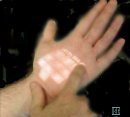
invention ideasOne of the newest invention ideas in interface devices is Skinput.
This invention allows the surfaces of your body to be used as a touchscreen.
This is how it works.
An armband projects the image of a menu or keyboard onto your hand or forearm. This armband also contains an bio-acoustic sensor that can detect and analyze sound frequencies.
Because of bone density, joints, and soft tissue, different locations on the body have different acoustic properties.
When you tap your finger on different parts of your body it creates a unique frequency based on the specific area.
Skinput can detect what part of a projected image you are touching and in turn can transmit a wireless signal to a computer, smart phone or other device.
Skinput was created by the project team of Desney Tan, a senior researcher in the Visulization and Interaction Area at Microsoft Research; Dan Morris, a researcher in the Computational User Experiences at Microsoft Research; and Chris Harrison, a third year Ph.D student in the Human-Computer Interaction Institute at Carnegie Mellon University.

Printing's New Level

                                              Three Dimensional Printing

three dimensional printing
Inventors Max Bogue and Peter Dilworth have invented a unique pen that draws in the air.
A colorful spool of plastic thread is fed into the pen.
The thread is then extruded as heated plastic that cools and solidifies instantly as it exits the tip.
This allows solid 3D structures to be drawn on any surface or from any surface into the air.
The pen, called a 3Doodler, weights approximately 7 ounces (198 g) and is 7 inches (17.7 cm) long. It requires no technical knowledge or software and plugs into an electrical outlet.
Max and Peter have received over 2.2 million dollars worth of advanced orders for their three dimensional printing pen.
They expect to fulfill those orders and launch the product in the fall of this year.
The co-inventors met while working for WowWee, a company based in Hong Kong that develops consumer technologies.
Peter consulted WowWee as an independent inventor. He had previously worked on robotics at MIT and contributed to a number of innovations including the infamous Uno Dicycle motorcycle.
Max was an R&D project manager with WowWee and has extensive experience in bringing products to market.


Wednesday, October 28, 2015

Lose Weight Now Ask Me How......

Scientific Balance Food can change human lifestyle.....

Contact number +919825 654 781
                            +917600 583 764

                 Sterilizing Spray

latest science inventions
This latest science invention is a spray-on invisible thin glass coating that sterilizes, protects and strengthens surfaces.
The coating also repels water, dirt, stains, mildew, fungus, bacteria and viruses.
A liquid coating invented at the Saarbrücken Institute for New Materials in Turkey and patented by Nanopool GmbH Germany, is a flexible and breathable spray-on glass film.
The film is approximately 100 nanometres thick (500 times thinner than a human hair) and has multiple applications and uses in numerous fields.
The coating is environmentally friendly (Winner of the Green Apple Award).
It can be applied within seconds to make any surface very easy to clean and safe from anti-microbes (Winner of the NHS Smart Solutions Award).
The special glass coating known as "SiO2 ultra-thin layering" protects practically any surface against water, UV radiation, dirt, heat, acid, stains, mildew, fungus. bacteria and viruses.
Trials by food processing plants in Germany have concluded that surfaces coated with liquid glass only need hot water for cleaning. In fact, the coating provided higher levels of sterility than surfaces cleaned with bleach or other chemicals.
A year long trial at a British hospital in Southport, Lancashire is to be published soon with very promising results for a wide range of coating applications used on medical equipment, implants, catheters, sutures and bandages.
Trials for in-vivo applications are confidential, but Neil McClelland, the UK Project Manager for Nanopool GmbH, describes the results as "stunning".
"Items such as stents can be coated, and this will create anti sticking features. Catheters and sutures which are a source of infection, will also cease to be problematic," he says.
Colin Humphreys, a professor of materials science at Cambridge University, commented that liquid glass appears to have a wide range of applications and that the product 'looks impressive'.
The investment opportunities for this latest science invention seem endless - buildings, vehicles, appliances, clothing etc. can have dirt and germ free surfaces without using toxic coatings or chemicals.

Big Day


                              Today's History

October 28 

312: Constantine the Great defeats Marcus Aurelius Valerius Maxentius at the Mulvian Bridge.

969: After a prolonged siege, the Byzantines end 300 years of Arab rule in Antioch.

1216: Henry III of England is crowned.

1628: After a fifteen-month siege, the Huguenot town of La Rochelle surrenders to royal forces.

1636: Harvard College, the oldest institution of higher learning in the United States, is founded in Cambridge, Mass.

1768: Germans and Acadians join French Creoles in their armed revolt against the Spanish governor of New Orleans.

1793: Eli Whitney applies for a patent on the cotton gin, a machine which cleans the tight-clinging seeds from short-staple cotton easily and effectively–a job which was previously done by hand.

1863: In a rare night attack, Confederates under Gen. James Longstreet attack a Federal force near Chattanooga, Tennessee, hoping to cut their supply line, the "cracker line." They fail.

1886: The Statue of Liberty, originally named Liberty Enlightening the World, is dedicated at Liberty Island, N. Y., formerly Bedloe’s Island, by President Grover Cleveland

1901: Race riots sparked by Booker T. Washington’s visit to the White House kill 34.

1904: The St. Louis police try a new investigation method: fingerprints.

19146: The German cruiser Emden, disguised as a British ship, steams into Penang Harbor near Malaya and sinks the Russian light cruiser Zhemchug.

1914: George Eastman announces the invention of the color 
photographic process.

1919: Over President Wilson’s veto, Congress passes the National Prohibition Act, or Volstead Act, named after its promoter, Congressman Andrew J. Volstead. It provides enforcement guidelines for the Prohibition Amendment.

1927: Pan American Airways launches the first scheduled international flight.

1940: Italy invades Greece, launching six divisions on four fronts from occupied Albania.

1944: The first B-29 Superfortress bomber mission flies from the airfields in the Mariana Islands in a strike against the Japanese base at Truk.

1960: In a note to the OAS (Organization of American States), the United States charges that Cuba has been receiving substantial quantities of arms and numbers of military technicians" from the Soviet bloc.

1962: Soviet Premier Nikita Khrushchev orders Soviet missiles removed from Cuba, ending the Cuban Missile Crisis.

1965: Construction completed on St. Louis Arch; at 630 feet (192m), it is the world’s tallest arch.

1971: Britain launches the satellite Prospero into orbit, using a Black Arrow carrier rocket; this is the first and so far (2013) only British satellite launched by a British rocket.

1982: The Spanish Socialist Workers’ Party wins election, giving Spain its first Socialist government since the death of right-wing President Francisco Franco.

2005: Libby "Scooter" Lewis, chief of staff to Vice President Dick Cheney, resigns after being indicted for "outing" CIA agent Valerie Plame.

2007: Argentina elects its first woman president, Cristina Fernandez de Kirchner.

 Born on October 28

1875: Gilbert Grosvenor, editor, turned the National Geographic Society’s irregularly published pamphlet into a periodical with a circulation of nearly two million.

1896: Howard Hansen, composer, director of the Eastman School of music.

1903: Evelyn Waugh, English novelist who wrote Decline and Fall and Brideshead Revisited.

1909: Francis Bacon, English artist who painted expressionist portraits.

1912: Richard Doll, English epidemiologist who established a link between tobacco smoke and cancer.

1914: Jonas Salk, U.S. scientist who developed the first vaccine against polio.

1926: Bowie Kuhn, Commissioner of Major League Baseball (1969–1984).

1936: Charlie Daniels, country / Southern rock singer, songwriter, musician ("The Devil Went Down to Georgia").

1938: Anne Perry, an author of historical detective fiction, she was herself convicted at age 15 of aiding in the murder of a friend’s mother in New Zealand; their crime was the basis for the 1994 film Heavenly Creatures.

1944: Anton Schlecker, founder of the Schlecker Company, which operated retail stores across Europe.

1949: Bruce Jenner, athlete, actor; won gold medal in the Decathlon at the Summer Olympics in Montreal (1976).
1951: Joe R. Lansdale, author ("Hap and Leonard" novel series, "Bubba Ho-Tep"); won World Horror Convention Grand Master Award 2007.

1955: William "Bill" Gates, the chairman and CEO of Microsoft Corporation, the world’s largest software firm.

1967: Sophie, Hereditary Princess of Liechtenstein.

1967: Julia Robert Downey Jr​s, actress (Pretty Woman, Steel Magnolias; won Academy Award for Best Actress in Erin Broc6kovich).

1967: John Romero, game designer, developer; co-founded id Software (Doom, Quake).

1972: Brad Paisley, country / Southern rock singer, songwriter, musician ("I’m Gonna Miss Her," "Letter to Me"); his many awards include the Country Music Association’s Entertainer of the Year 2010.